Understanding Environmental Remediation Timelines in New Jersey
When contamination is discovered, most property owners immediately ask: how long is this going to take?
The environmental remediation timeline New Jersey projects follow is rarely simple. Some properties can be cleared in a matter of weeks, while others may remain in remediation for months—or even years.
What makes timelines challenging is that they depend on real-world conditions, not just process steps. Soil type, contamination spread, regulatory oversight, and site access all influence how quickly a project can move forward.
If you’re also evaluating financial impact, it’s helpful to compare timelines with environmental remediation cost in New Jersey expectations, since longer projects almost always increase total cost.
The Fastest Possible Remediation Timelines (Best-Case Scenarios)
In ideal conditions, environmental remediation can move surprisingly fast.
A best-case environmental remediation timeline, New Jersey scenario typically involves:
- Limited contamination confined to a small area
- No groundwater impact
- Easy site access
- Straightforward regulatory approval
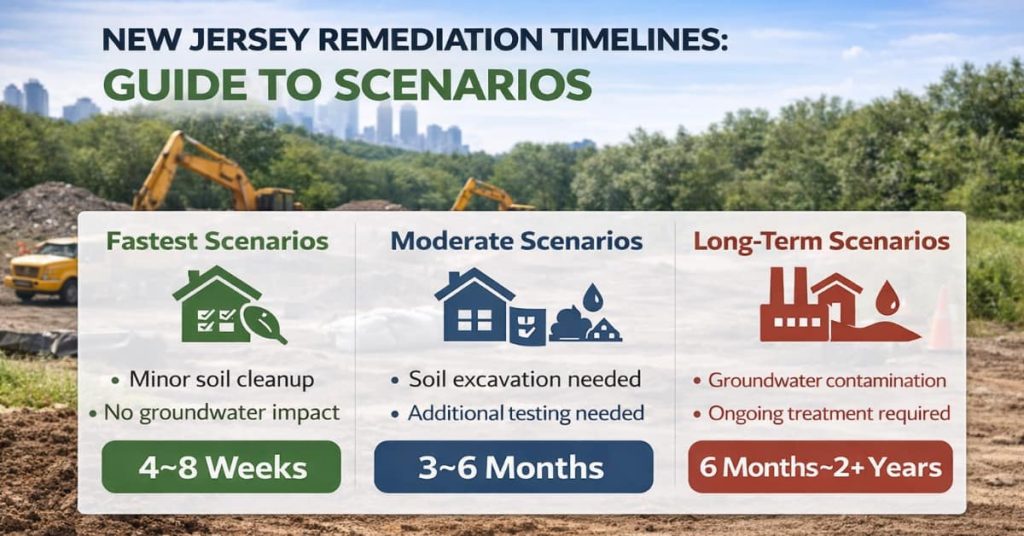
In these cases, timelines may look like:
- Initial testing and confirmation: 2–4 weeks
- Cleanup and removal: 1–2 weeks
- Final testing and closure: 2–4 weeks
Total timeline: 4 to 8 weeks
These types of projects are most common in smaller residential properties or isolated contamination events.
Moderate Timeline Scenarios (Most Common in NJ)
Most projects fall into a middle category—not extremely simple, but not overly complex either.
A moderate environmental remediation timeline in New Jersey typically includes:
- Soil contamination requiring excavation
- Additional sampling and verification
- Some regulatory coordination
Typical timelines include:
- Investigation and confirmation: 4–8 weeks
- Cleanup and remediation work: 4–12 weeks
- Final testing and approvals: 4–8 weeks
Total timeline: 3 to 6 months
This is the most common timeframe for residential and light commercial properties across New Jersey.
Long-Term Remediation Timelines (Complex Projects)
More complex sites can significantly extend the environmental remediation timeline that New Jersey property owners should expect.
These situations often involve:
- Groundwater contamination
- Large-scale industrial impact
- Ongoing treatment systems
- Multiple rounds of testing and monitoring
In these cases, timelines may extend to:
- Active remediation: 6 months to several years
- Monitoring and verification: ongoing
Total timeline: 6 months to 2+ years
These projects are more common in older commercial or industrial sites.
You can visualize the remediation timeline scenarios below.
Why Some Environmental Projects Take Longer Than Expected
Even when a project starts with a clear plan, timelines can shift. The environmental remediation timeline New Jersey properties follow is often affected by factors that are not immediately visible.
The most common causes of delays include:
- Unexpected contamination discovered during cleanup
- Weather conditions impacting excavation or access
- Regulatory review timelines and documentation requirements
- Groundwater migration requiring extended monitoring
- Limited site access in developed or urban areas
Each of these can add weeks—or even months—to a project.
Soil vs Groundwater: The Biggest Timeline Difference
One of the most important distinctions in any environmental remediation timeline, the New Jersey project is whether contamination is limited to soil or involves groundwater.
Soil Cleanup Timelines
Soil remediation is typically:
- Faster
- More predictable
- Easier to complete in a single phase
In many cases, soil can be excavated, removed, and verified within weeks.
Groundwater Cleanup Timelines
Groundwater remediation is significantly more complex and time-intensive.
It often requires:
- Installation of monitoring wells
- Continuous treatment systems
- Periodic sampling over time
Because groundwater moves and spreads, cleanup cannot always be accelerated.
This is the single biggest reason timelines extend into months or years.
How NJ Regulations Affect Remediation Timelines
New Jersey has one of the most structured environmental remediation systems in the country. While this ensures safety and compliance, it also impacts timelines.
Projects must follow:
- Licensed Site Remediation Professional (LSRP) oversight
- NJDEP standards and reporting requirements
- Documented verification before closure
For official guidance, refer to the New Jersey Department of Environmental Protection site remediation program
You can also explore how compliance affects project flow in navigating environmental remediation requirements across NJ.
Real-World Timeline Examples in New Jersey
Looking at real-world scenarios helps clarify how the environmental remediation timeline in New Jersey varies.
Example 1: Small Residential Spill
- Minor soil contamination
- No groundwater involvement
Timeline: 4–6 weeks
Example 2: Residential Property with Moderate Soil Impact
- Larger excavation required
- Multiple testing rounds
Timeline: 2–4 months
Example 3: Commercial Property with Groundwater Contamination
- Monitoring wells installed
- Ongoing treatment required
Timeline: 6–18 months+
How Remediation Timelines Impact Property Transactions
Environmental timelines play a major role in buying, selling, or refinancing property.
Delays in the environmental remediation timeline in New Jersey can:
- Push back closing dates
- Affect financing approvals
- Create negotiation challenges
Buyers often require:
- Completed environmental assessments
- Defined remediation plans
- Regulatory closure documentation
Understanding who is responsible for environmental cleanup costs in NJ is also critical during transactions.
How to Keep Your Remediation Project Moving
While some delays are unavoidable, many projects can stay on track with the right approach.
Best practices to maintain timeline efficiency:
- Start early: Address contamination as soon as it is identified
- Use experienced professionals: Reduce errors and rework
- Ensure accurate testing: Avoid delays from incomplete data
- Maintain communication: Keep all stakeholders aligned
These steps can significantly improve the environmental remediation timeline that New Jersey property owners experience.
When to Act: Timing Matters
Delaying remediation almost always leads to longer timelines.
Contamination can:
- Spread into new areas
- Reach groundwater
- Trigger additional regulatory requirements
Acting early helps keep timelines shorter and more predictable.
What to Expect Moving Forward
The environmental remediation timeline New Jersey property owners face is not fixed—but it is predictable when you understand the variables involved.
From fast-track residential cleanups to long-term commercial remediation, the key is knowing what to expect and planning accordingly.
With the right strategy and guidance, projects can move efficiently while staying compliant with New Jersey regulations.
Move Forward with Confidence
Understanding your timeline is just as important as understanding your cost. The sooner you have clarity, the better positioned you are to make informed decisions.
All American Environmental helps property owners across New Jersey navigate environmental remediation from start to finish—keeping projects on track, compliant, and efficient.
Get a Clear Timeline for Your Property
If you’re dealing with contamination or planning a property transaction, now is the time to understand your timeline.
Contact All American Environmental today to evaluate your site, define your remediation timeline, and move forward with confidence.